Where individual grid upgrades are unavailable, collaboration can often create headroom. An energy hub pools the supply and demand of neighbouring businesses — with its own legal and financial ground rules.
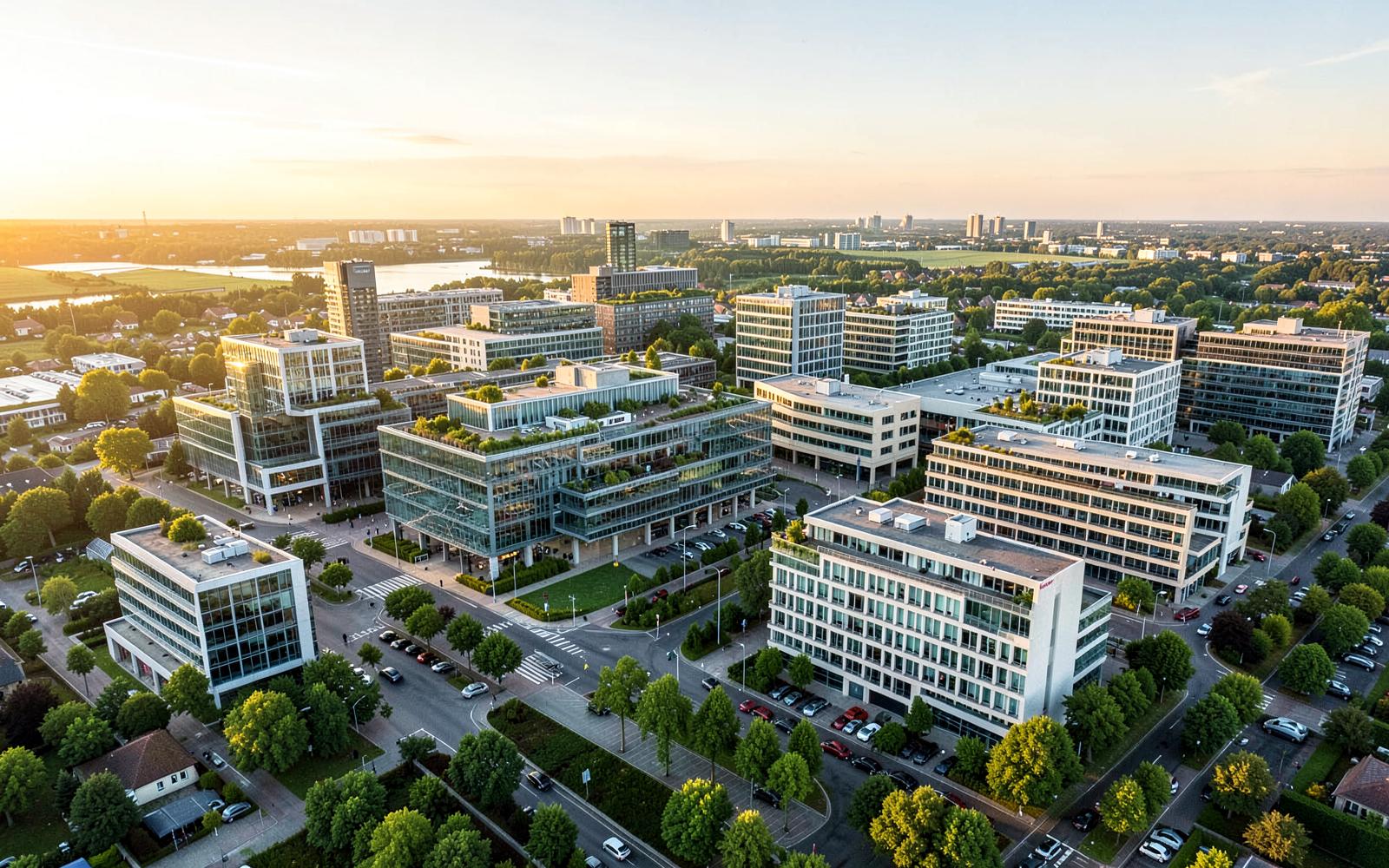
On business parks across and around Eindhoven, companies with vastly different consumption profiles operate side by side: a manufacturing plant with a morning peak, a cold storage facility with a constant load, an office with an afternoon peak, and a logistics operator charging overnight. Individually, each hits the limits of their own connection. Together, they make substantially better use of the available capacity.
That is the concept behind an energy hub: coordinating demand, generation, and storage across multiple businesses so that the same grid capacity delivers more work. This article covers the operational models, necessary agreements, and financing.
Models of collaboration
The first approach incurs minimal cost and often delivers quick results. As you move towards shared assets, the benefits increase, but so do the demands on governance, liability, and financing.
- Mutual coordination of charging and production schedules, without shared infrastructure
- A shared storage or generation facility utilised by multiple businesses
- A group transmission agreement (groepstransportovereenkomst) where participating parties collectively stay within a single agreed capacity limit
- A joint legal entity that owns and operates the installation and apportions the costs
Agreements to establish in advance
- Who owns the installation and who is responsible for maintenance
- How capacity and costs are allocated, and what happens if one participant exceeds their allowance
- What happens if a participant enters insolvency, relocates, or expands
- How revenues from savings or grid feed-in are distributed
- Which decisions require unanimity and which require a majority
- How a new participant joins and what financial contribution is required
Why financing works differently here
In a joint project, a lender evaluates the weakest link. If one participant defaults, the asset remains in place, but part of the cash flow disappears. It is therefore vital that the participant agreement provides for continuity: how a departing participant's share is absorbed and which obligations remain binding.
In practice, there are two routes. Under a joint legal entity, that entity finances the asset, backed by participant contributions as cash flow and the installation as collateral. Under a host model, a single business invests and sells capacity or energy to neighbours on multi-year contracts; these contracts then substantiate the finance application.
Regional context
In the Brainport region, business parks are relatively compact and business associations are actively organised across many estates. This makes collective initiatives far more viable than in areas where premises are dispersed. At the same time, the pressure is acute: the combined demand from advanced manufacturing, data infrastructure, and fleet electrification is growing faster than grid capacity can be expanded.
For individual business owners, this means it pays to align with existing initiatives from the local business association or park management rather than pursuing a standalone solution. Financing can then be structured per participant, allowing each business to account for its own share on its balance sheet.
Next steps
- Map the consumption profiles of participating businesses and verify whether they complement each other
- Involve the grid operator (netbeheerder) early; they can confirm which arrangements are feasible within your grid area
- Have a participant agreement drawn up before any capital is committed
- Choose between a joint entity and a host model, and align the financing structure accordingly
- Document for each participant which proportion of the investment and savings belongs to that business
Frequently asked questions
- What exactly is an energy hub?
- A collaborative arrangement where neighbouring businesses coordinate their demand, generation, and storage, enabling the same grid capacity to support greater commercial activity.
- Who finances a shared installation?
- This can be a joint legal entity supported by participant contributions as cash flow, or a single host business that invests and supplies capacity to neighbours under multi-year contracts.
- What happens if a participant withdraws?
- This must be stipulated beforehand in the participant agreement: transfer of the equity share, ongoing liabilities, and accession terms for a replacement participant.